On day one of neuromodulator training , you learn where the corrugator sits. Day two, you feel it move under your fingers while a live model watches you in the mirror. That gap is the whole point of a two-day program.
Day one builds the foundation:
- Facial and muscular anatomy
- Product knowledge
- Dosing logic
- Safe injection practice
- Consultation skills
Day two turns that foundation into repetition:
- Multiple procedures across five treatment areas with an instructor beside you the entire time.
You arrive as a licensed professional curious about aesthetics. You leave holding a syringe like it belongs in your hand.
What Actually Happens on Day 1?
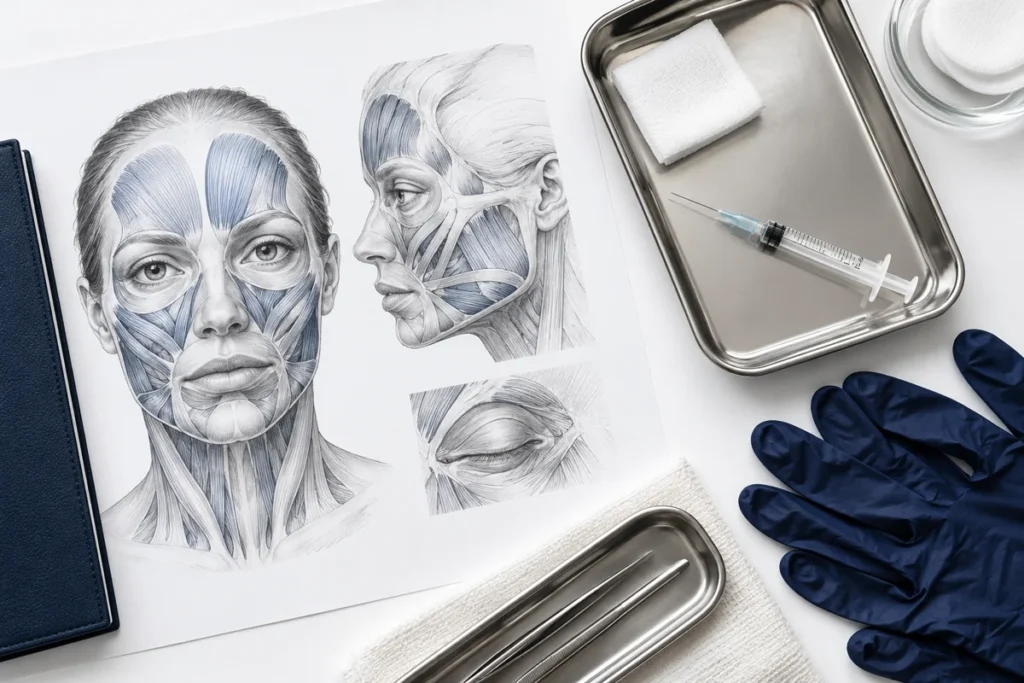
Morning is classroom work, and it is denser than most people expect. You cover the neuromodulator products available in your state and everything related to them. This includes how they differ in onset, diffusion, and unit conversion. Once you know the basics, you move on to how to reconstitute, store, and document them properly. Facial anatomy follows, layer by layer, until you can trace them all. From frontalis to corrugator, procerus, orbicularis oculi, and nasalis, you follow them on a face rather than a diagram.
The clinical safety content sits in this block too:
- Absolute and relative contraindications, with the consultation questions that surface them
- Dosing logic and why the same number of units produces different results on different faces
- Danger zones, particularly around the orbital rim and the brow depressors
- Ptosis, brow heaviness, asymmetry, how each happens and how to avoid causing them
- Managing expectations, onset timelines, and the two-week review
- Documentation, consent, lot recording, and aftercare instructions that patients actually follow
Afternoon is where the tone shifts. Neuromodulator training that keeps you in a chair all day produces graduates who still feel like observers, so day one ends with your hands on a real face under direct supervision.
Why Does the Anatomy Portion Matter More Than People Expect?
Because injecting is a decision, not a technique. Two patients arriving with identical frown lines often need different treatment plans depending on whether their brow depressors or their frontalis dominate. Reading that difference is the skill separating an injector who produces consistent results from one who produces surprises.
Instructors spend time on muscle interplay for exactly this reason. Treating the glabella without accounting for frontalis activity is how brows drop. Treating crow’s feet without assessing the lower orbicularis is how smiles change shape. The anatomy hours feel academic until you are standing in front of your first model, at which point they become the most useful thing you learned.
When Do You Hold Your First Syringe?
Sooner than most people assume. Once the safety and anatomy foundation is in place, you move to injecting on live models with an instructor shadowing you. That shadowing model is deliberate. You hold the syringe, you choose the injection points, you control the depth and the angle, while an experienced practitioner stands close enough to correct your hand position in real time.
Watching someone else inject builds familiarity. Injecting yourself builds competence. A neuromodulator course that relies mainly on demonstration leaves you needing a second course before you feel ready to treat a paying patient.
What Changes on Day 2?
Volume and refinement. Day two takes you through the full procedure count across five treatment areas, and the repetition is what converts technique into muscle memory.
The minimum breakdown looks like this:
- 2 models for bunny lines
- 2 models for lip flip
- 3 models for frontalis lines
- 3 models for glabellar lines
- 3 models for crow’s feet
Thirteen procedures across five areas give you something a single demonstration cannot: variation. Different face shapes, different muscle strength, different skin thickness, different expectations in the chair. Your third glabella feels noticeably different from your first, and that is precisely the progress the second day exists to produce.
What Do the Different Treatment Areas Teach You?
Each area trains a separate skill:
- Glabellar Lines teach depth control and respect for the danger zone near the brow
- Frontalis Lines teach restraint, since over-treating this muscle is the most common beginner error
- Crow’s Feet teach superficial technique and careful placement outside the orbital rim
- Bunny Lines teach precision in a small area where a millimetre changes the outcome
- Lip Flip teaches micro-dosing, where the difference between a good result and a flat smile is tiny
Working across all five in two days also shows you how a full-face assessment comes together, which is how patients actually present in clinic.
What Does Real-Time Feedback Actually Look Like?
Correction as it happens rather than after the fact. Your instructor watches your angle before the needle enters the skin, comments on your injection depth as you go, and reviews your placement pattern once the model is done. You hear what you did well and what to adjust while the memory is still fresh.
That feedback loop covers the practical details nobody writes down:
- How to hold and stabilize the face with your non-dominant hand
- Where to stand so you can see asymmetry properly
- How to talk to a nervous patient while you work
- How to mark and plan before touching the syringe
- How to recover composure when a model flinches
What Can You Realistically Do the Week After?
Offer neuromodulator injections in the five areas you trained on, within your provincial scope of practice and with whatever prescriber relationship your college requires. Confidence in the upper face, familiarity with consultation and consent, and a documented record of supervised procedures put you in a position to start treating carefully selected patients right away.
Most graduates begin with friends and family, build their photo library, and expand as their eye sharpens. The two days give you the foundation. Your first fifty patients give you the judgment.
Reserve your spot in NAIMA’s next neuromodulator training with their “Learn Today and Pay Later” and start injecting with confidence.